EdgeTX Battery and GPS Voice Callouts (Part 4)
EdgeTX Cockpit Voice, part 4 of 9. Making a RadioMaster GX12 speak its own telemetry, so a low battery is something I hear instead of something I forgot to look at.
‹ Part 3: Three Buttons, Three Colours, and the AND Gate · Part 5: Where the Callouts Come From › · Start at part 1
The switches from Part 3 are just booleans until something turns them into sound. That something is EdgeTX special functions, and this is where the config stops being structure and starts being a voice in my ear.
The special functions
This is where a boolean becomes a sound.
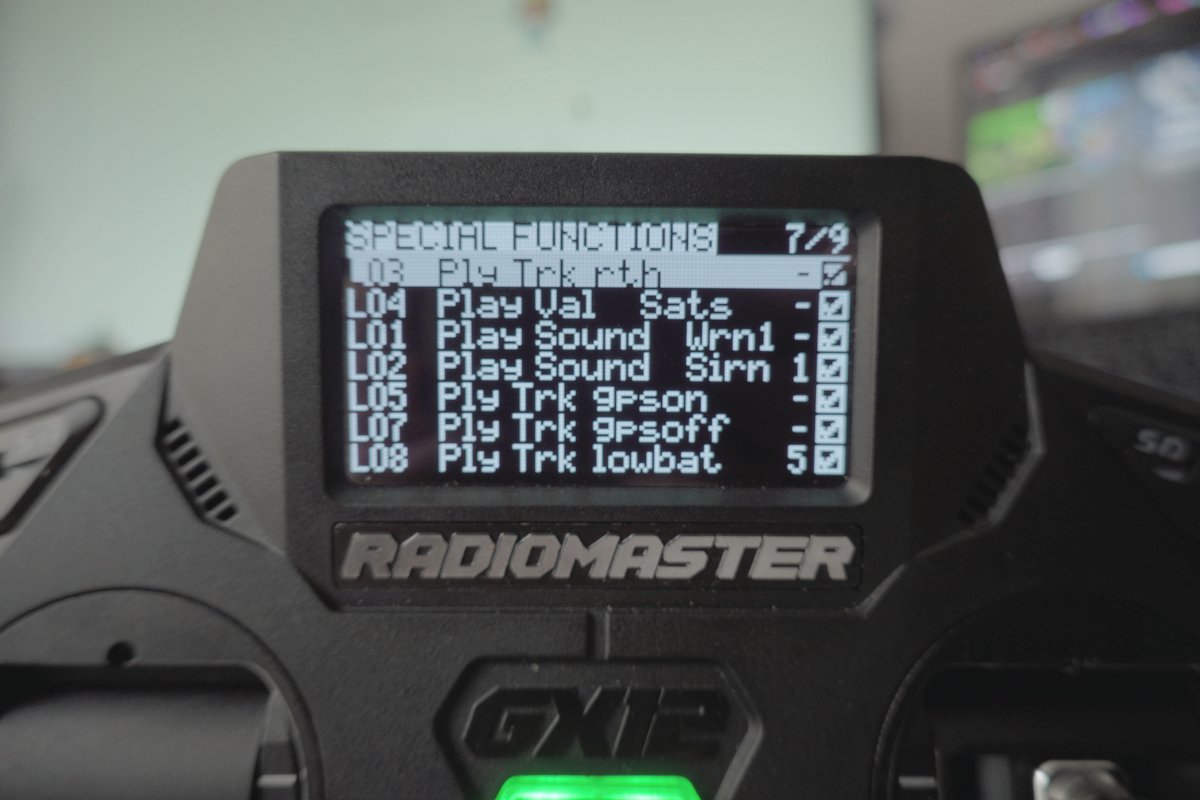
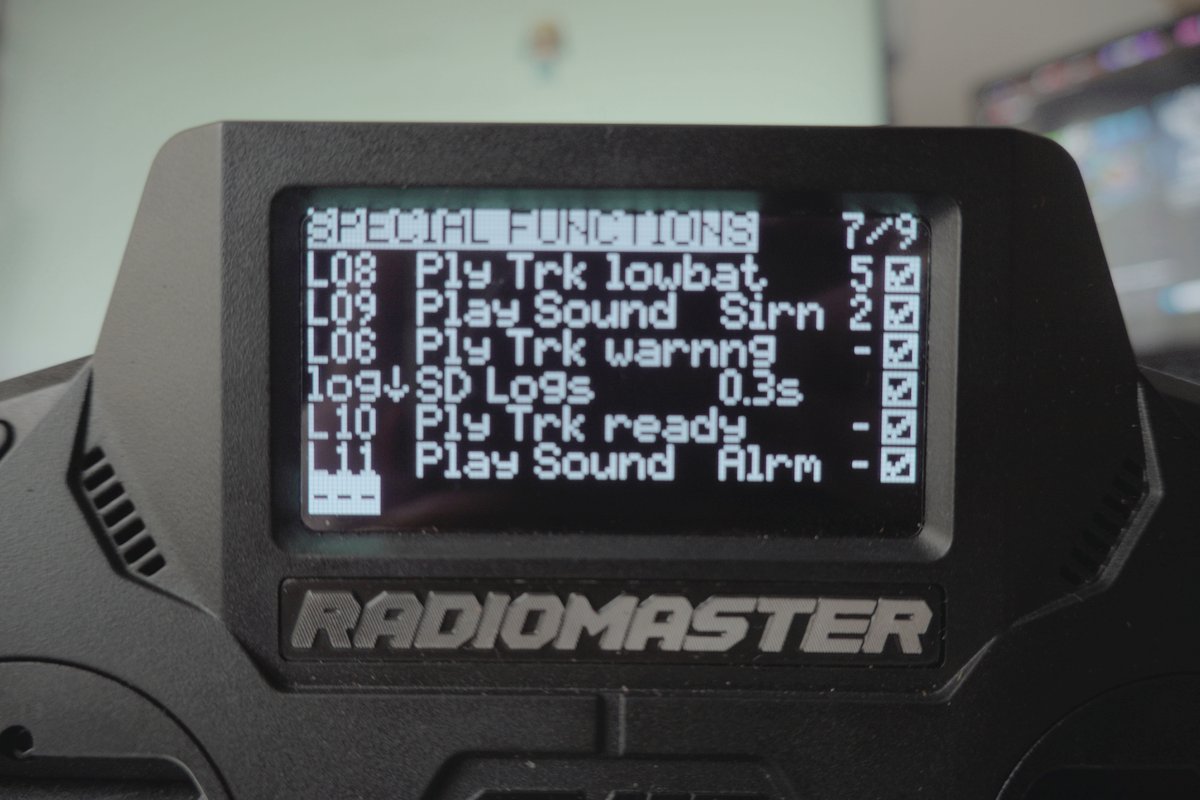
 1customFn:
 2   0:  { swtch: "L3",   func: PLAY_TRACK, def: "rth,1,1x"     }
 3   1:  { swtch: "L4",   func: PLAY_VALUE, def: "tele(22),1,1x" }
 4   2:  { swtch: "L1",   func: PLAY_SOUND, def: "Wrn1,1,1x"    }
 5   3:  { swtch: "L2",   func: PLAY_SOUND, def: "Sirn,1,1"     }
 6   4:  { swtch: "L5",   func: PLAY_TRACK, def: "gpson,1,1x"   }
 7   5:  { swtch: "L7",   func: PLAY_TRACK, def: "gpsoff,1,1x"  }
 8   6:  { swtch: "L8",   func: PLAY_TRACK, def: "lowbat,1,5"   }
 9   7:  { swtch: "L9",   func: PLAY_SOUND, def: "Sirn,1,2"     }
10   8:  { swtch: "L6",   func: PLAY_TRACK, def: "warnng,1,1x"  }
11   9:  { swtch: "SW42", func: LOGS,       def: "3,1"          }
12   10: { swtch: "L10",  func: PLAY_TRACK, def: "ready,1,1x"   }
13   11: { swtch: "L11",  func: PLAY_SOUND, def: "Alrm,1,1x"    }
The third field in def is the repeat interval. 1x means play once per
trigger. 1 means every second, 5 means every five seconds. That distinction
matters more than it looks, see below.
Put together, the behaviour is this:
The battery ladder — green button
| Per-cell | Switch | Sound | Repeat | Meaning |
|---|---|---|---|---|
| > 4.2 V | L10 | ready | once | Fresh pack detected — system armed and talking |
| < 4.0 V | L1 | Wrn1 | once | You are flying now, clock is running |
| < 3.8 V | L3 | rth | once | Roughly half capacity — turn around |
| < 3.6 V | L2 | Sirn | 1 s | Get home |
| < 3.5 V | L8 | lowbat | 5 s | Land, wherever you are |
| < 2.9 V | L11 | Alrm | once | You have hurt the pack |
The ready callout at > 4.2 V is not a warning at all. It is a self-test. When I plug a battery in and the radio says "ready", I
have just confirmed, in one word, that: telemetry is flowing, the RxBt sensor is
alive, report_cell_voltage is actually set on this aircraft, and the audio
path works. All four failure modes of the entire system, verified by one word,
before I take off. If the radio stays quiet when I plug in, something in the
chain is broken and I want to know now, not at 800 metres.
Caveat on LiHV: a 4.35 V/cell pack sails past 4.2 V, so ready fires reliably.
A LiPo that has been sitting on the shelf for a week self-discharges toward
4.15 V and may never trip it. That is arguably correct behaviour, it is telling
me the pack is not actually full.
The rth callout at 3.8 V is the one that has genuinely saved flights. It
is a crude approximation of half capacity, made from voltage rather than
coulombs, and I am not going to pretend it is accurate. But it does not need to
be accurate. It needs to arrive while I still have the energy budget to act on
it, which a coulomb counter that I am not looking at does not achieve. Note
that it is gated on the gps button, not the battery button, it is a
long-range-mission warning, and on a whoop in a hotel room it would just be
noise.
And to be explicit about the other half of long range, because it is not optional and no amount of telemetry replaces it: my wife maintains visual line of sight on the aircraft through binoculars the entire time. The audio warnings tell me about the aircraft's state. They tell me nothing about the airspace.
The GPS callouts — blue button
Satellite count is a genuinely bad thing to monitor visually, because the moment it matters most is the moment you are least able to look.
| Condition | Switch | Sound | Meaning |
|---|---|---|---|
| Sats > 6 | L4 | speaks the number | Approaching usable — how close are we? |
| Sats > 13 | L5 | gpson | Solid fix, rescue is trustworthy |
| Sats < 6 | L7 | gpsoff | Fix degraded mid-flight |
PLAY_VALUE on L4 is the nice one, instead of a fixed tone it speaks the
actual satellite count. So while I am waiting on the ground I get "seven",
"nine", "eleven" as the fix builds, and I know whether to keep waiting or give
up, without unlocking the radio screen.
The threshold that actually matters is 6, because that is roughly where
GPS Rescue becomes something you can trust, and the exact number depends
entirely on your own rescue configuration in Betaflight or INAV. Set it to
match your gps_rescue_min_sats, not mine.
The gpsoff warning at Sats < 6 is the one I did not expect to need and now
consider essential. Acrobatics drop satellites. Roll the aircraft
inverted and the patch antenna is pointing at the ground; hard flips and
power loops routinely knock the count down. If that happens on a long-range
flight and I do not know about it, I am flying with a rescue function that
will not work, believing that I have a safety net. One word in my ear fixes
that.
The altitude alarm — always armed
L6 has andsw: "NONE", it is armed on every flight, on every aircraft. I fly
under EASA A1/A3, and the 120 m AGL limit is not a preference.
But here is where I have to be honest about my own config, because reading the YAML back taught me something about it:
1   5:
2      func: FUNC_ADIFFEGREATER    # |delta| >= x
3      def: "tele(21),120"
FUNC_ADIFFEGREATER is |Δ| ≥ x, the delta function. It does not fire
when altitude exceeds 120 m. It fires when altitude has changed by 120 m
from its reference point.
I could pretend I planned that. What I will say is that it turns out to be the more defensible choice, for a reason worth understanding:
GAlt on CRSF is GPS altitude, not height above your launch point. If I had
used the obvious a > x on GAlt with a 120 m threshold, it would scream at me
constantly and permanently, because I fly in Lithuania, where the ground itself
sits around 70–150 m above sea level. The alarm would be true before the
aircraft left my hand.
The delta function sidesteps that entirely: it measures change, so the reference is wherever I started, and 120 m of climb is 120 m of climb regardless of the elevation of the field. That is much closer to AGL than absolute GPS altitude is.
It is not perfect, and I want to name the imperfections rather than paper over them:
- It also fires on a 120 m descent, since it is absolute-value delta. Fly off the edge of a valley and it will warn you.
- After it fires, the reference updates, so it re-arms and fires again on the next 120 m change rather than staying latched above the limit.
- It is a warning, not a limit. It tells me I have climbed a long way. Staying legal is still my job.
This is the part I would most like to improve, and I have not measured a
better version yet. The right answer is probably to derive a true
launch-relative altitude, which the barometer already provides in the OSD but
which is not what lands in the GAlt telemetry sensor. If you have solved this
cleanly in EdgeTX, I want to hear about it.
That is the system as I fly it. Six spoken tracks, three satellite states, one altitude alarm that turned out to measure something other than what I thought.
Series: EdgeTX Cockpit Voice, part 4 of 9. Making a RadioMaster GX12 speak its own telemetry, so a low battery is something I hear instead of something I forgot to look at.
‹ Part 3: Three Buttons, Three Colours, and the AND Gate · Part 5: Where the Callouts Come From › · Start at part 1