Why EdgeTX Voice Telemetry Beats the OSD (Part 1)
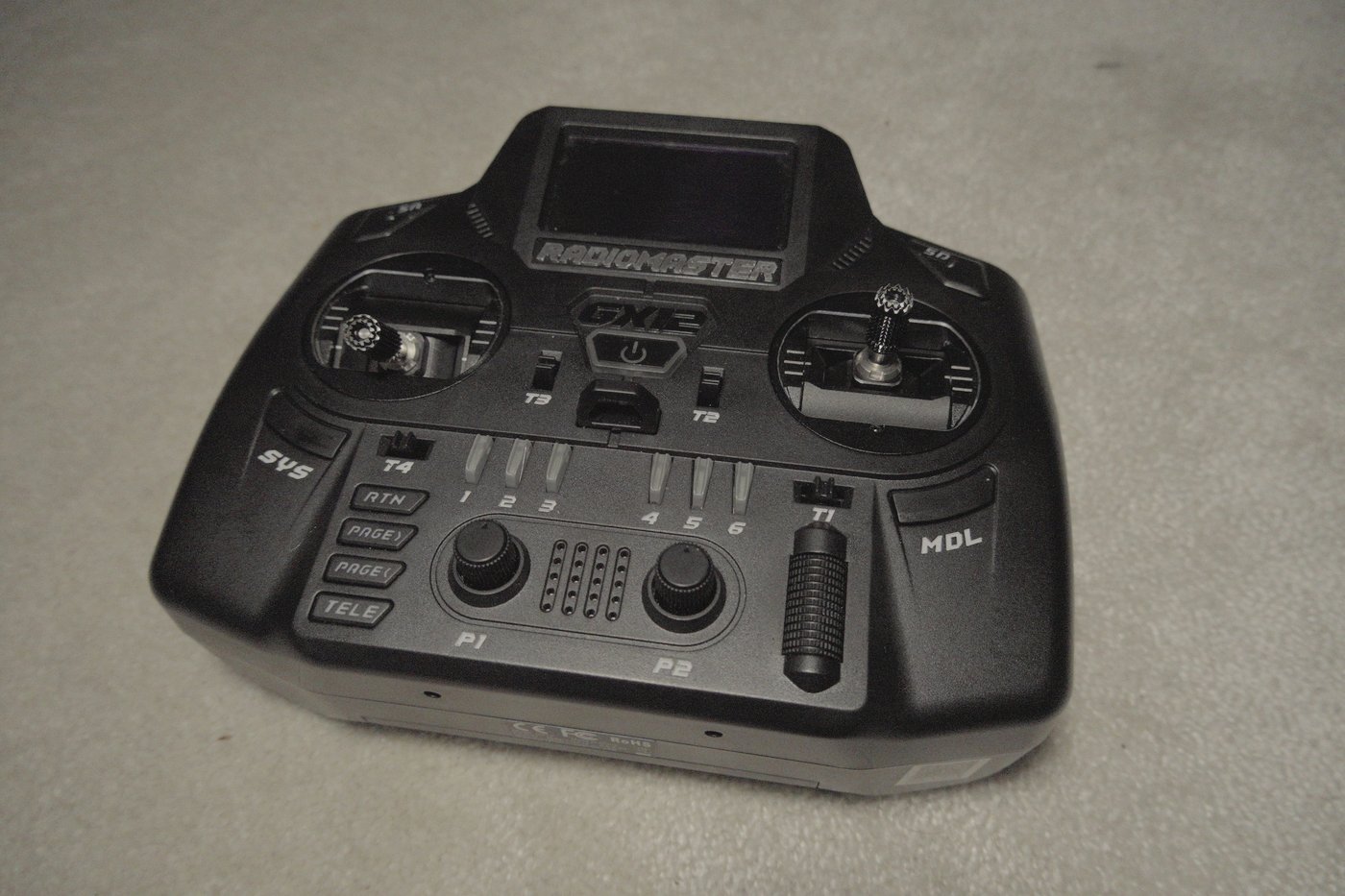
EdgeTX Cockpit Voice, part 1 of 9. Making a RadioMaster GX12 speak its own telemetry, so a low battery is something I hear instead of something I forgot to look at.
You know the flight. You are a long way out, the terrain is good, the lines are flowing, and you are entirely inside the goggles. Somewhere in the corner of the OSD a voltage number has been quietly dropping for the last ninety seconds and you have not looked at it once, because you were busy flying. Then the OSD starts blinking at you, and you do the arithmetic: distance home, headwind, remaining sag. And the arithmetic says no.
That flight ends in a walk. Sometimes it ends in a walk with a bag.
The thing that always bothered me about this failure mode is that it is purely an interface problem. The data was there the whole time. The radio knew. The quad knew. The only broken link in the chain was that the information was rendered as small glowing digits in the periphery of a human who was concentrating on something else.
An aircraft would never do this to you
Here is the part that struck me as absurd. Put a pilot in a Cessna and the aircraft will not let a low-fuel state be a visual detail you might miss. It will say so. Out loud. Repeatedly. Gear-up warnings, stall warnings, altitude callouts, terrain warnings. An entire century of aviation human-factors engineering converged on one conclusion: for time-critical state changes, audio beats vision, because audio does not require the pilot to look somewhere.
And yet the default FPV configuration for a 250-gram aircraft with a four-minute endurance is... a number in the corner of the screen.
So I fixed it. My GX12 now talks to me. Not with a Lua script, not with anything exotic, just EdgeTX logical switches and special functions, which have been sitting in the firmware the whole time.
This is the first time I have built this, and I want to be upfront: there are less clumsy ways to do parts of it. I will show you exactly where mine is clumsy and why, because that is more useful than pretending I got it right first time. But the core of it works, and one specific warning, the half-capacity "return home" callout, has genuinely saved flights for me on long range missions. It gives me the cue to start planning the trip back while I still have the budget to make it, instead of discovering the problem when the budget is already spent.
Step zero: make every drone speak the same language
This is the single change that makes the whole system possible, and it happens on the flight controller, not on the radio.
By default, the CRSF battery frame reports pack voltage. That is useless as a fleet-wide trigger, because my fleet spans 1S to 4S. A "3.5 V" threshold means nothing when one aircraft runs a single 18650 and another runs a 4S LiHV pack. I would need a different threshold set per model, maintained by hand, forever.
So I set every aircraft to report average cell voltage instead. In Betaflight this is a single parameter:
1set report_cell_voltage = ON
2save
It is also exposed in the Betaflight configurator under Power & Battery as "Report cell voltage instead of pack voltage in telemetry". The FC divides pack voltage by its detected cell count before it ever reaches the telemetry frame.
Now 3.5 V means the same physical thing on the 1S whoop, the 2S rippers and
the 4S 3-inch. One threshold ladder, whole fleet.
Note on the INAV equivalent: I run Betaflight on everything relevant here, so I have only verified this on Betaflight. If you are on INAV, check the parameter name before assuming it is identical — I have not measured it.
Why not do the division in EdgeTX instead?
You can. EdgeTX lets you set a custom Ratio on a telemetry sensor, so you could leave the FC reporting pack voltage and divide by cell count in the radio.
I deliberately did not, and you can see the decision in my config, the RxBt sensor has no correction applied at all:
 1telemetrySensors:
 2   14:
 3      id1:
 4         id: 8              # CRSF frame 0x08, BATTERY_SENSOR
 5      id2:
 6         instance: 0
 7      label: "RxBt"
 8      unit: 1               # volts
 9      prec: 1               # one decimal place
10      cfg:
11         custom:
12            ratio: 0        # no scaling
13            offset: 0       # no offset
Two reasons for doing it on the aircraft instead:
- The ratio is per-model in the radio, but the cell count is per-battery. A radio-side divide-by-four is wrong the moment I fly the same airframe on a 3S pack.
- LiHV breaks a hardcoded guess. My 3-inch runs 4S LiHV at 4.35 V/cell fully charged, 17.4 V on the pack. A radio that has been told "assume 4S" copes fine, but a radio doing cell-count detection from a divided number does not. The FC already knows its own cell count from the actual detection logic. Let the thing that knows do the maths.
The trade-off is honest: doing it FC-side means every new aircraft needs that CLI line, and if you forget it, your warnings fire at absurd times. So it belongs on the setup checklist for a new build, next to the things you cannot see either.
One threshold ladder now means the same physical thing on every aircraft I own. Next: the three buttons that decide which warnings are allowed to speak, and the AND gate that keeps them from tripping over each other.
Series: EdgeTX Cockpit Voice, part 1 of 9. Making a RadioMaster GX12 speak its own telemetry, so a low battery is something I hear instead of something I forgot to look at.